


Don’t fall for the misconception that search-optimized content should be written exclusively for robots. Even though Google has over 200 ranking factors that determine what will appear top on the results page, writing for search engine optimization (SEO) is all about meeting the needs of the user.
Even things like website speed — how much it takes for your page to load — are going to affect the performance of your content. Users will give up on you if your website is too slow. In fact, if your page load time goes from 1 to 5 seconds, the likelihood of bounce rate increases by 90%, per Google’s research. A high bounce rate suggests that something is wrong with what you have to offer — and this signal will affect your results, no matter how compelling your writing is.
The takeaway: Delivering a superior user experience (UX) is crucial to achieving SEO results. When it comes to SEO writing itself, there are specific techniques and best practices that help ensure that you will leave crawlers and readers satisfied with your content.
In this guide, we go over the basics of SEO content writing for beginners.
What is SEO writing?
SEO writing is the creation of content that is optimized for search engine algorithms. You output articles and pages that target keywords that people are searching for — but simply using the right keywords won’t put you on the first page of Google if your content is poorly researched and written. What you have to offer needs to be relevant to search queries by answering users’ questions with authoritative, deep knowledge. And you also have to organize your article or webpage in a way that it’s easier for Google to understand and index.
You need to get the content structure right, too, because how you write is equally important as what you write. That’s SEO writing in a nutshell.
SEO writing guidelines for beginners
As a creative content marketing agency and SEO consultancy, our team at Productive Shop is often brought in to train in-house content teams or subject matter experts (SMEs) on how to ensure they are writing with the SEO basics in mind.
We put these tips together considering that you have already done your keyword research and built an SEO editorial calendar. So you know what to write and have the knowledge to output content that is original and comprehensive. Here are our top 10 best practices for SEO writing. Dig in! 👇
1. Follow the brand style guide for consistency
A writing style guide gives clarity about your brand’s tone of voice and standards for grammar, spelling and punctuation. At Productive Shop, we start website copywriting projects by putting together style guidelines that help us ensure that the copy is consistent.
In following a style guide, watch out for:
- Use of sentence case vs title case for headings
- Use of the Oxford comma, contractions and hyphenation of compounds
- Spelling of specific words (e.g., cyber threats vs cyberthreats)
☝️ Inconsistency makes your content look sloppy and low quality, which can impact your SEO results and brand reputation.
💡 Need help staying away from a sloppy copy? Read our guide on how to avoid grammar and spelling errors that hurt your brand credibility and lead generation efforts.
2. Structure the content with headings
Users and crawlers alike want an overview of what your article covers — a reason why headings are critical to effective SEO content structure. In fact, 39% of articles lacking H2s are low-performing, according to The State of Content Marketing 2022 Report.
Following an advanced heading structure (with H2 + H3 + H4) helps readers better understand what your article is about – and scan through it. Your article should have only one H1, where you are placing your most important keyword. Think of your headings as branches of a tree, connected to the trunk (your H1). You have H3s under your H2s. And your H2s are under your H1.
Let’s say you are writing a guide on cloud computing. You can have an H2 about benefits and another H2 about challenges. Under benefits, you can have an H3 focused on each benefit. Here’s a rough overview:
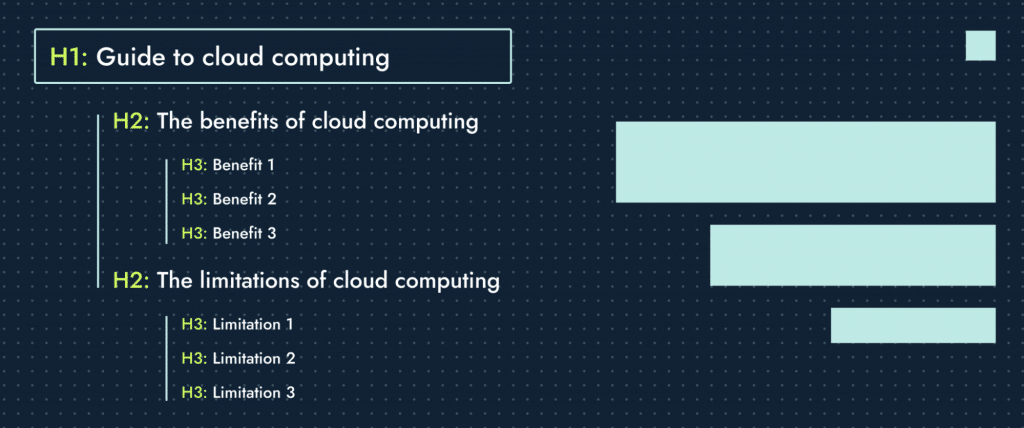
This content structure gives the reader an idea of what the article is about just by scanning it.
For this reason, each heading needs to be contextually relevant and descriptive of the content under it. Since search engine crawlers pay close attention to the article structure, headings are gold for keywords, too.
💡 Interested in SEO writing best practices for heading tags? Read our guide on how to optimize headers.
3. Pay attention to keyword placement
With your keyword research in hand, you might know exactly which keywords to use, but it’s only part of the equation. In our experience, these are the top SEO writing mistakes when it comes to keyword replacement:
❌ You use your main keyword only in the H1 ❌
Your H1 keyword is your most important keyword. You should use it in the body text as well (at least 3 times: at the beginning, mid-post and ending of your article). But be careful to avoid keyword stuffing (let’s say, no more than 9-15 times depending on the length of your article).
You should also use synonyms. For example, if your main keyword is “IT OT convergence,” you should also use alternatives such as “OT IT convergence” or “IT OT alignment.”
❌ You overuse your H1 keyword in your H2s and H3s ❌
Your H2s are an opportunity to place other important keywords. And these keywords should be specific to the topic under your H2. In other words, avoid repeating your H1 keyword in your other headings. Using the same keywords too many times in different H2s triggers the Penguin algorithm and you’re flagged for keyword stuffing. You can use your H2 keywords in the body text, too.
❌ You concentrate your keywords on only a section of the article ❌
You need to distribute your keywords throughout your content. You need to give Google’s algorithm signs that your entire article is about the topic, not only the first half, for example.
You also need to include related words that might not have search volume. The reason: Google is smart enough to understand that those words are contextually relevant to your topic. Skip to our tip #10 if you want to learn about the SEO tools that offer keyword recommendations.
💡 Need help with keyword research? Here’s how to find low-difficulty keywords with high volumes.
4. Make the text easy to scan
Enhanced readability is one of the top SEO writing rules. Start by keeping your paragraphs in a visually digestible format. Your paragraph should be short, so you have more open spaces instead of a long block of text.
Our recommendation is to not go over 5 lines so that it is easier for the reader to scan the article. According to Semrush’s The State of Content Marketing report, “51% of low-scoring texts have paragraphs that are too long.” Writing short paragraphs isn’t enough to make it scannable, though. We recommend breaking down the content every 2-4 paragraphs. Here’s how:
- Headings. We covered this topic in tip #2, but it’s worth repeating that headings are a great opportunity to incorporate keywords and sum up what a section is about.
- Bullet points. If you are going to expand on each point, use bold to highlight key terms (like the way we’ve done here).
- Visuals. Make sure your post includes at least one image or video because visuals help with SEO, too. We will cover the importance of alt texts in tip #8.
Bolding important words and phrases attracts the reader’s attention to what is important. This tactic also helps Google better understand what has more value to you — so if you are using keywords in sentences in bold, it’s even better.
“Does bolding important points on a paragraph help the SEO? Yes, it does. It does help us better understand that paragraph or that page.” (John Mueller, Google Search Advocate)
5. Write clear, direct and concise sentences and paragraphs
Embracing plain language is one of my favorite writing tips – ever. For improved readability, you should use short and simple words because good writing simplifies things. Choose your words with precision and avoid vagueness, jargon, wordiness and fluffiness. Write simple and short sentences in active voice.
Get rid of what you don’t need. Be conversational but not superficial. You need to write authoritatively, exploring your topic in depth to ensure that you are leaving the reader satisfied.
💡 Need help? Check out Grammarly or Hemingway — two of the best writing tools for new and seasoned writers alike.
6. Add crosslinks and don’t neglect your anchors
Crosslinks are foundational to any SEO campaign. Google understands links (internal and external) as signals of the quality of a page or site. Adding crosslinks to other pages of your site helps to build up their authority, too. Internal links help Google better understand your website’s structure and make the reader discover more content, spending more time on your site.
So let’s say you are outputting a blog post to your resource center. Your post should reinforce a topic or page on your website. Ask yourself which main topic cluster or page you want to push and link to it. Take this blog post as an example. The topic here (our H1 keyword) is “SEO writing,” so we are linking to our “content writing” service page. We linked to it in our third paragraph using the anchor “SEO content writing.”
💡 Your anchor text should be relevant to what you are writing and the page you are linking to. Do not use generic anchor texts (for example, “click here”).
We have a few more recommendations when it comes to links:
- Do not link to your own homepage. Be specific and link to a product or service page.
- Avoid crosslinking to an excessive amount of external web pages. Make sure they are really authoritative and relevant to your topic. Using reputable sources is also an indication that you have done your research and are outputting high-quality content.
- Don’t concentrate all your links in one section of your article. Spread them out throughout the piece. Avoid using more than two links per paragraph. Don’t add links to your first paragraph (you want to keep the reader on your page for longer before they go to check something else).
- Go directly to the sources. For example, if you want to quote a study by Gartner, link to the report’s landing page on Gartner’s website (not a news article covering the findings of the report).
💡 Anchors are a big deal in SEO. Learn the ins and outs of effective SEO anchor text with our guide.
7. Write meta tags
Meta tags describe the content of a page when searchers find it on the results page.
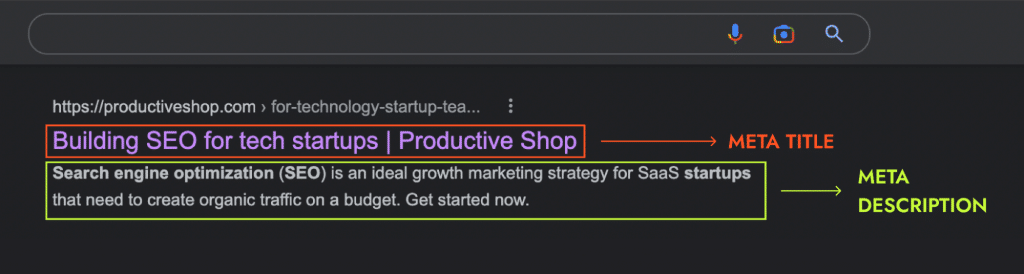
Meta tags need to be catchy because you want to incite searchers to click. For this reason, you should:
- Use actionable language.
- Ensure the title tag is under 60 characters.
- Keep your meta descriptions between 140 and 155 characters. Having descriptions that are too short, long or irrelevant to the search queries increases the chance that Google might rewrite them. It’s better if you can keep your own copy, especially if you spent time crafting a click-worthy meta.
- Include target keywords in both the meta title and description. If you can use the keyword toward the front, it’s even better.
Google doesn’t use the meta description as a ranking factor, but if someone is searching for those words, they will appear in bold in the description, which helps to attract the searcher’s attention. When it comes to meta titles, there are two approaches:
- You use your H1 as your meta title, too.
- You target a different but similar keyword in your meta title.
Which one is better? Our clients have been successful with both strategies.
💡 Keep in mind that meta tags play a direct role in your click-through rates (CTRs), so it should not be an afterthought. CTR is a very important SEO metric because a successful search optimization project is not only about keyword rankings but also about conversions.
👉 Need help crafting compelling meta tags? Read our guide on how to write SEO-friendly meta titles and descriptions.


